 Raydium
 Swap Quotes, Wallet Approval, and Transaction Checks
Raydium turns a selected Solana token input and output into a live swap quote, then builds a wallet transaction against one or more liquidity pools. Before approval, the relevant checks are the route, quoted input or output, the corresponding slippage boundary, pool and token fees, price impact, and network cost. Submitting the signed transaction sends the swap to Solana; confirmation follows only after the network processes it.
Updated
That exchange flow sits beside liquidity provision, token launches through LaunchLab, and a separate perpetuals product. Each uses a different mechanism, so a spot quote does not describe the terms of a launch or a leveraged position.
Pool routes behind a usable quote
A usable quote can draw from a single pool, several pools in sequence, or a split across eligible pools. CPMM and AMM v4 pools use constant product pricing, while CLMM pools concentrate liquidity within chosen price ranges. The router compares eligible paths after their configured fees and estimates which path provides the highest output for the selected input.
A routed swap can pass through more than one pool, with each hop pricing the trade through its own pool curve. Pool fees and state changes accumulate across that path. A route with extra hops may still estimate a better output, while a direct route has fewer pool states that can change before execution.
An exact-input quote fixes the amount sent, estimates the amount received, and uses a minimum output as its slippage boundary. An exact-output quote fixes the desired output, estimates the required input, and uses a maximum input as its slippage boundary. In either mode, the figures describe a current route rather than a settled exchange. The input and output mint addresses establish which tokens the transaction will use.
Minimum output and the changing quote
For an exact-input quote, the acceptance boundary is the minimum output derived from the quote and selected slippage tolerance. The relationship is minimum output = quoted output × (1 - slippage tolerance). If pool state moves far enough that execution would return less, the transaction should fail instead of accepting that lower amount.
Slippage tolerance is not a fee, and widening it does not improve the initial quote. It expands the range of outcomes that the transaction may accept. Price impact measures something else: the estimated change caused by the trade relative to available liquidity. A larger order against a shallow pool generally has greater impact than the same order against deeper usable liquidity.
Token behavior can alter the net amount as well. When a Token-2022 mint applies a transfer fee, the useful figure is the amount expected after that fee, not a gross pool output. Priority fees address transaction scheduling during congestion; they do not improve the pool price. These values should be read together before the wallet prompt appears.
Wallet approval and transaction boundaries
A wallet approval authorizes the transaction message presented for signature; it does not make the underlying quote permanent. Connecting a wallet exposes its public account and lets the application request transactions, but connection alone does not move tokens. Before signing and submitting, confirm that the sending asset, receiving asset, limits, and fee payer match the selected swap.
A standard spot swap may require the wallet to sign one or more Solana transactions. One of those transactions may create a token account for the output mint when the wallet does not already have one, increasing the SOL required. A request for a recovery phrase or private key falls outside swap authorization. Those credentials control the wallet itself and should never be entered into a trading interface.
Some wallet prompts summarize complex program calls more clearly than others. The practical comparison remains the same: the transaction should reflect the intended direction, acceptable input, minimum output, and network cost. A simulation warning, unfamiliar mint, or unexplained instruction is a reason to reject the request and verify the transaction details before trying again.
Checks before committing a spot swap
A spot swap is ready for signing only when the live quote still meets the chosen acceptance condition and the wallet prerequisites are in place. The following checks keep the durable transaction rules separate from values that can move while the quote is open.
- Confirm the input and output mint addresses, not only their displayed symbols.
- Confirm the wallet holds the input amount and enough SOL for network fees and any required token-account creation.
- Read the route, pool fees, transfer fees, and price impact wherever the interface shows them.
- For exact input, compare expected output with minimum received. For exact output, compare expected input with maximum input. Reject terms that no longer meet the selected boundary.
- Match the wallet prompt to the selected action, without entering a recovery phrase or private key.
A refreshed quote may change the route or expected output, while a rebuilt transaction may use a different priority-fee setting. If the updated values still satisfy the acceptance boundary, the rebuilt transaction may be signed. An interface message does not prove completion by itself; a confirmed transaction record and matching token balance changes provide the observable result.
Liquidity pools and provider trade-offs
Liquidity provision is a separate action from accepting a swap quote. A provider deposits assets into a pool and receives a position representing a claim on that liquidity. Swap fees can accrue to the position under the pool's rules, while changes in the relative asset prices can make the position perform differently from holding each asset separately.
CPMM and AMM v4 distribute liquidity along a constant product curve. CLMM lets a provider select a price range, concentrating usable liquidity within that range and requiring more active position management. The pool program, configured fee, mint behavior, withdrawal path, and current range status all affect the position. A liquidity deposit therefore deserves its own transaction review.
LaunchLab from bonding curve to pool
LaunchLab handles token launches through a bonding curve that can graduate into a CPMM pool after its configured threshold is met. Before graduation, trades use the launch curve. Reaching the threshold changes the trading state by migrating liquidity under the launch configuration, so a pre-graduation quote and a later pool quote describe different mechanisms.
Platform configuration can affect creator fees, platform fees, and post-migration pool settings. The mint address identifies the token before and after migration; a familiar name or symbol does not.
Spot pools and perpetual markets
Raydium Perps uses a central limit order book powered by Orderly Network rather than Raydium's spot liquidity pools. A spot swap exchanges tokens through an on-chain pool transaction. A perpetual position creates derivative exposure backed by collateral and governed by margin, funding, and liquidation rules.
Perpetual deposits and withdrawals touch the chain, while order placement can occur without a new Solana transaction each time. Market availability, leverage limits, and risk parameters belong to the live perpetual venue. A spot route's minimum output, pool fees, and price impact do not describe a perpetual fill or its liquidation risk.
A spot swap ends with a token balance exchange. Trading on the perpetual venue creates a margined long or short position with separate collateral and exit conditions.
How can a completed swap be checked?
A confirmed Solana transaction record can show status, signer, fee, invoked programs, and token balance changes. Start with the transaction signature returned after submission. A success status shows that the instructions executed, while matching balance changes show whether the intended input decreased and the intended output increased.
Mint addresses and net balance changes are stronger evidence than a ticker or an interface notification. Token transfer fees and newly created token accounts can change how the result appears in a wallet. If the record succeeds but the asset remains hidden, refresh the wallet display and inspect the token account tied to the output mint.
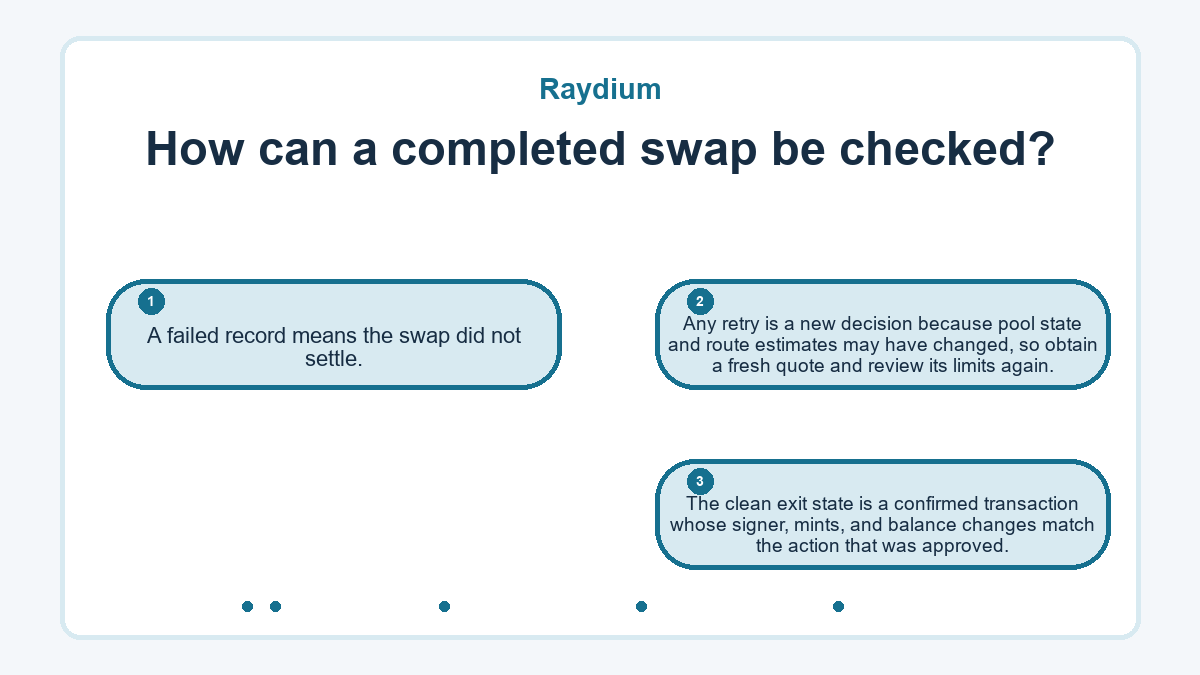
A failed record means the swap did not settle. Any retry is a new decision because pool state and route estimates may have changed, so obtain a fresh quote and review its limits again. The clean exit state is a confirmed transaction whose signer, mints, and balance changes match the action that was approved.
Raydium: reader questions
How long does a Raydium quote remain usable?
No fixed duration is guaranteed for a quote. It remains actionable only while the transaction stays valid and the resulting output remains within its slippage boundary. Pool swaps and network delay can make an older quote unusable. If the interface rebuilds the transaction or its values move, review the new minimum output before signing.
Can a confirmed Raydium spot swap be reversed?
No, a confirmed spot swap cannot be reversed. Reversing the economic exposure requires a new swap at the quote then available, which may have different fees, price impact, and output. Before submission, reject an unwanted wallet request. After submission, use the transaction signature to determine whether the swap succeeded or failed.
Does Raydium take custody of assets between spot swaps?
Raydium does not take custody of assets between standard spot swaps. The wallet authorizes a transaction that exchanges tokens through on-chain pool programs rather than depositing them into a general account for later matching. Liquidity positions and perpetual collateral are separate arrangements with their own balances and withdrawal conditions.
Can every Raydium pool trade Token-2022 assets?
No, not every Raydium pool can trade every Token-2022 asset. AMM v4 does not support Token-2022, while CPMM and CLMM support Token-2022 assets subject to their mint extensions and pool configuration. A token existing on Solana does not guarantee an eligible pool or usable route, so check both its mint and the selected pool type.
When can a failed spot swap still use SOL?
A failed on-chain transaction can still use SOL because Solana charges transaction fees whether execution succeeds or fails. A preflight rejection that never reaches the chain is different and may not create an on-chain fee record. The transaction signature and recorded fee show whether a submitted attempt was processed.
Does LaunchLab graduation guarantee deep liquidity?
No, LaunchLab graduation does not guarantee deep or durable liquidity. Graduation means the configured threshold triggered migration from the bonding curve to a CPMM pool. Future volume, price impact, and usable liquidity still depend on reserves, trading activity, mint behavior, and pool configuration. Evaluate the post-graduation market through its current quote and on-chain pool state.